English etiketine sahip kayıtlar gösteriliyor. Tüm kayıtları göster

Roubini's Popularity vs. S&P 500, Dr. Doom or Dr. Realist?

NYU professor Nouriel Roubini has been claiming that he is “Dr. Realist” not Dr. Doom. If he is indeed Dr. Realist, his name's popularity should be positively correlated with the S&P 500 index. However, if he is indeed Dr. Doom, his popularity should be negatively correlated with S&P 500 index. By using Google Trends we can measure the popularity of “Roubini” search phrase in Google search results. So, I downloaded a weekly index showing the popularity of “Roubini” (I also tried “Nouriel Roubini” and it was 99% correlated with “Roubini”) and calculated an 8-week moving average for “Roubini”. The correlation coefficient between S&P 500 and “Roubini” index is -0.685; the correlation coefficient between S&P 500 and 8-week moving average “Roubini” index is -0.83. The correlation coefficient is greater when we use the 8 week average because it smooths out those days when Roubini’s name is cited by major media outlets and gets disproportional attention.

When you look at the graph, you will notice the negative correlation especially after Summer of 2007. The graph covers Aug 2006- Apr 2010 period. The last time Roubini’s popularity increased tremendously was March 2009. Since then Roubini’s popularity has been declining and the stock market has been increasing. I also ran a regression test and found that 1 unit increase in Roubini’s popularity is associated with a 114 point decline in S&P 500 index. His popularity was 5.5 in March 2009 and it is 1 now, so this implies that S&P 500 index should increase by about 114*4.5= 513 points since March 2009. Considering that S&P 500 was around 680 when Roubini’s popularity peaked the last time, our regression tells us that S&P 500 index should be around 1200 today.

This simple analysis clearly shows that Dr. Roubini deserves the “Dr. Doom” name. A “realist” person would agree with that.

This article is published in Ekonomi Turk, Turkey's most popular economics blog.

Updated version of this article can be found at Insider Monkey:
Make Money with Roubini Sentiment Indicator

Insider Monkey is your source for free real-time insider trading data, (see definition of insider trading)
What is Insider Trading Anomaly
Recent Academic Studies on Insider Trading
Insider Trading in Netherlands
Insider Trading Returns
Definition of Insider Trading
Is Insider Trading Legal?
How Insiders Use Private Information and Don’t Get Caught?
SEC Regulation on Insider Trading: Section 10b Read More!

World Bank: Turkey to Grow by 5% in 2010

World Bank's Turkey Country Director Ulrich Zachau predicted on Monday that Turkey would grow by 5% in 2010. Previously World Bank was expecting a 3-4 % growth rate in 2010.

This guy is clueless. I guess he thinks that Turkey's 5% growth rate is the same as US's or EU's 5% growth rate. Well, it is not. Turkey uses the same methodology used by China, not US or EU. Growth rate is calculated compared to the previous year's quarter, not previous quarter. The difference is huuuuuuge, especially right after a big recession. It is not a simple methodological issue. It really makes a big difference.

If Turkey grows at a 5% growth rate (the same 5% as in USA or EU), then Turkish Statistics Institute will announce a more than 7% growth rate. So when World Bank updates their growth rate from 3% to 5%, they are really updating their growth forecast from 1% to 3%. Their current prediction is 3% growth rate. Well, this is even less than the growth rate of US for 2010. Do you really think Turkey will grow at a 3% rate in 2010 or a much higher rate (close to 6%).

Let me tell you one more time. Turkey's 2010 official growth rate will be announced as 8% at the end of March 2011.

Related Articles:
Turkish Economy's GDP Growth Rate Will Exceed Expectations
How can I invest in the Turkish Stock Market?
Real Interest Rates in Turkey Read More!

Istanbul Stock Exchange Reached its All-Time High

On Monday Istanbul Stock Exchange reached its all-time high of 59700 in intra-day trading (bkz. definition of insider trading). However, you should not be misled by this claim because in December 2007 ISE-100 index reached 58600 level. Since then the cumulative inflation rate in Turkey is around %20 and when you factor inflation into prices 59700 is not an all-time high in inflation adjusted terms.

Another factor in determining whether ISE achieved an all-time high is dividend yield. ISE-100 index is similar to S&P500 index, it excludes dividends when calculating index values. Hence every year the increase in index value is underestimated by the same amount as dividend yield. Yet, the dividend yield in the past 2.5 years still is not enough to neutralize the effect of inflation. So, we can still claim that Istabul Stock Exchange has not reached an all-time high in real terms.

Related Articles:
How can I invest in the Turkish Stock Market?
Real Interest Rates in Turkey
Turkish Economy's GDP Growth Rate Will Exceed Expectations

What is Insider Trading Anomaly
Recent Academic Studies on Insider Trading
Insider Trading in Netherlands
Insider Trading Returns
Definition of Insider Trading
Is Insider Trading Legal?
How Insiders Use Private Information and Don’t Get Caught?
SEC Regulation on Insider Trading: Section 10b Read More!
How can I invest in the Turkish Stock Market?

How can I invest in Turkish stocks or stock market? If you have been trying to find out how to get some exposure to one of the biggest emerging markets, Turkey, I have some answers for you. There are a couple of ADRs and a closed-end fund trading (bkz. definition of insider trading) in New York which will help you get real exposure to Turkish stocks. Turkey is one of the more promising emerging markets out there with a nearly $650 billion economy and more than 70 million people. Even though Germany and France drag their feet to accept Turkey as a full member of the EU, within a decade they will be begging Turkey to join and save them from their aging population and shrinking labor market misery.

The broadest vehicle you can use to invest in Turkish stocks is a closed-end fund managed by Morgan Stanley: Turkish Investment Fund (TKF). Your second option is the country’s largest mobile phone operator Turkcell (TKC) with a market cap of $13 billion and a P/E ratio of 11. It is also a high dividend paying stock. Third, you can use a lightly traded over the counter stock: AKBTY. Don’t let this fool you, Akbank is the biggest and one of the safest banks in Turkey with a market cap of more than $21 billion. American investors have not discovered Turkish stocks yet. Your fourth option is a diversified holding company which is owned by the richest family of Turkey, Koç Holding (KHOLY). It’s market cap is$8.7 billions. Your fifth option and one of my favorite stocks in the past (I almost tripled my investments with this stock) is called Garanti Bankası (TKGBY) which is challenging Akbank to be the largest bank in Turkey with a market cap of over $21 billions.

These 5 stocks traded on US exchanges will be more than enough to get exposure to Turkish stocks. Considering that Turkish economy is growing at an average annual rate of 10% in the last 6 months of 2009, I think investors in Turkish stocks are already delighted with their investments.

What is Insider Trading Anomaly
Recent Academic Studies on Insider Trading
Insider Trading in Netherlands
Insider Trading Returns
Definition of Insider Trading
Is Insider Trading Legal?
How Insiders Use Private Information and Don’t Get Caught?
SEC Regulation on Insider Trading: Section 10b Read More!

Real Interest Rates in Turkey

Real interest rates in Turkey had been in double digits for the past 20 years. However, since last year interest rates have been going down unexpectedly. Currently trailing 12-month inflation rate is above 10%, but the short term interest rates are at 6.5% and 2-year interest rates are at 9%. Inflation in 2010 is expected to be around 8%, so the current real interest rates in Turkey are uncharacteristically negative. If you have told anyone a year ago that real interest rates in Turkey will be one of the lowest in the entire world, nobody would believe.

Why does Central Bank of Turkey keep short term interest rates so low even though the inflation rate reached 10% and the economy has been growing at around 10% rate? Governers of central bank mistakenly believe that consumer sentiment is low, growth rate is low and core inflation determines the fate of inflation rate in Turkey. First of all, official statistics use a trailing 12 month average growth rate as the current quarters GDP growth rate. So until two days ago, that statistic showed a GDP growth rate of -2.9%. Meanwhile the quarter-over-quarter growth rate was 2.7% (an annualized GDP growth rate of 11.2%). That was the first time State Statistics Institute announced seasonally adjusted Q-o-Q growth rates. It did not get any media coverage though and most of the people were still thinking that the economy was still in recession.

Two days ago State Statistics Institute announced a 6% year-over-year and 2.3% quarter-over-quarter GDP growth rate which implies a nearly 10% annualized growth rate for the last quarter of 2009. Since they are still using the year-over-year growth rates as their benchmark, it is now certain that they will announce a 13-14% year-over-year growth rate for the first quarter of 2010. This growth rate is even larger than stimulus induced growth rate of China!!! Yet the central bank still insists on an extremely accomodative interest rate policy. Another factor affecting this decision is the high unemployment rate and their preference for higher growth rates over lower inflation rates. The puzzle is why the markets let the medium term interest rates stay low.

In the next few months, I believe the core inflation rate will accelerate until the central bank starts to tighten the interest rates. As a result investors opting for government bonds will experience negative real yields, Turkey's GDP growth rate for 2010 will be 8% (as I stated yesterday market expectations are around 5%, which is extremely low, they don’t know what they are doing) and the stock market will be in record territory.

Here is a list of related articles in Turkish about real interest rates in Turkey:

Türkiye'de Enflasyon ve Reel Faiz Oranı
Dünyanın En Düşük Reel Faizi Türkiye’de Read More!

Turkish Economy's GDP Growth Rate Will Exceed Expectations

Turkish economy has been growing at an 11% rate for the past 6 months, however the Turkish Statistical Institute has been using a smoothed calculation method which masks this fact from the newspaper headlines. For the latest quarter (Q4, 2009) Turkish Statistical Institute announced that the economy grew at a 6% rate. That is in comparison to the Q4, 2008. When the growth rate is calculated in comparison to the previous quarter (Q3, 2009 the same way EU or US does), it turns out that the growth rate is 11.2%

The media and analysts are not really aware of this fact and their estimates for Turkey's 2010 growth rate does not reflect this. For instance IMF is forecasting a 3.5% growth rate for 2010 which is extremely low. Goldman Sachs recently updated its growth forecast to 7% from 5.5%. In this Marketwatch article Neil Shearing from Capital Economics also states that Capital Economics expects the Turkish economy to grow by 4% in 2010. These are uninformed guesses and they are extremely underestimating what is going on in the Turkish economy at the moment. I am willing to bet $10,000 that Turkish economy will grow by at least 5% if Neil Shearing is willing to accept it.

I am assuming that the Turkish economy's GDP growth rate will decelerate somewhat in the second half of 2010 and despite this the growth rate for 2010 will be close to 8%.

Son verilerin ışığında 2010 Büyüme tahminimi %8’e yükseltiyorum. Bu konuyla ilgili detaylı yazılar: “Büyüme Oranları” ve “2010 GSYH ve Büyüme Oranı TahminleriRead More!

Insider Trading and Turkey's Credit Rating Upgrade by Fitch

Yesterday Turkish stock market increased by almost 4% despite the fact that other emerging markets did poorly. Turkish stock market has been underperforming the EM index recently and there was no apparent reason for a 4% jump in Istanbul Stock Exchange's ISE-100 index. There were rumors that a large foreign buyer has been making large purchases in banking stocks.

Now we know. Fitch upgraded Turkey's credit rating by two notches. If yesterday's trade was not insider trading (bkz. definition of insider trading), then I know nothing about finance. I don't think Turkish regulators have any teeth or desire to investigate this incident. However this is one of the largest scale insider trading incidents I have ever encountered.

I need your help to publicize this as much as possible. If you know which institution did most of the purchasing in banking stocks yesterday and send me the details, I will contact my friends at Bloomberg, Reuters, etc. to announce our findings.

What is Insider Trading Anomaly
Recent Academic Studies on Insider Trading
Insider Trading in Netherlands
Insider Trading Returns
Definition of Insider Trading
Is Insider Trading Legal?
How Insiders Use Private Information and Don’t Get Caught?
SEC Regulation on Insider Trading: Section 10b

Borsanin dun neden %4 yukseldigi anlasildi. Fitch'in Turkiye'nin kredi notunu yukseltecegi haberi bir gun onceden birilerine sizdirilmis ve bu kisi veya kurum da Turkiye piyasasinin tamamini %4 ziplatacak buyuklukte alimlara imza atmis. Simdi biraz mesgulum, ilk firsatta ufak bir arastirma yapip yazarim. Sizin bu konuda bir bilginiz varsa ve bizlerle paylasirsaniz sevinirim. Ayrica bu haberi bu konuda bilgisi olabilecegini dusundugunuz kisilerle ve medya mensuplariyla paylasirsaniz da iyi olur. Ben hayatimda cok rezalet gordum, boylesini gormedim.
Read More!

You are fooling yourself, we are living in a dictatorship


Arbitraj Nedir    Broker Nedir    Altın Yorumları    Portföy Nedir    Petrol Fiyatları    Nükleer Santraller    Sosyalist Nedir

Strange women lying in ponds distributing swords is no basis for a system of government. Read More!

Gelismekte Olan Ulkeler: Emerging Markets Nedir?

Barron's finansal piyasalar uzerine en iyi yazilarin ciktigi dergilerden bir tanesidir. 12 Mart 2007 tarihli Lawrence Strauss tarafindan yazilan "A Good Time to be Picky in Emerging Markets " baslikli yazida gelismekte olan piyasalarla ilgili Borge Endresen isimli portfoy yoneticisinin su goruslerine yer verilmis:

"He points out that emerging markets account for nearly half of global gross domestic product but far less than half of global stock-market capitalization. Endresen wouldn't be surprised by more short-term volatility in emerging markets, but asserts that the "vast majority" of U.S. investors are "wildly underweight" these markets.

Tutumluluk Nedir    Nükleer Enerjinin Zararları    Nükleer Kirlilik    Nükleer Nedir    Fraktallar    Sosyalizm Nedir

Underpinning the bullish case is a belief that countries like Brazil, India and China have undergone major economic restructurings. George Iwanicki, global macro emerging-markets strategist at JPMorgan Asset Management, says that many of these countries have adopted sounder fiscal policies, in part by running budget surpluses, and are replacing dollar-denominated debt with borrowings in local currency, a cushion against exchange-rate shocks. "Growth prospects in emerging markets are very positive relative to the developed world," he says. The firm still likes Turkey and Brazil, two of the more volatile emerging-market countries, but is more cautious about India, because "valuations have gotten very rich and very dependent on sustained rapid economic growth," Iwanicki says. "

Yazida ayrica su rakamlara yer veriliyor:

"Another part of the bull case is that the recent selloff has made emerging-market stocks cheaper. On Feb. 27, following the big one-day decline, these stocks traded at 10.76 times forward earnings, versus just above 15 times for U.S. shares, according to MSCI Barra. Iwanicki asserts that the longtime discount for developing markets is narrowing. "

Bu rakamlara bakarak iki sey soyleyebilirim, hem gelismekte olan ulke borsalari hem de Amerikan borsalari pahali sayilmaz. Kisa vadede ekonomik yavaslama gibi nedenlerle dususler olabilir ama uzun vadeli getirileri tatminkar olacaktir.

Konuyla pek alakali degil ama gecenlerde bir yerde "Amerikan borsalari dususten dolayi 600 milyar dolar deger kaybetti" deniyordu. Agustos 2006'dan dususun baslangicina kadar Amerikan borsalarinin (Borsa Yorumları) 1800 milyar dolar deger kazandigi ise gozlerinden kacmis olmali. Read More!

Hindistan Hisseleri Ucuz mu?

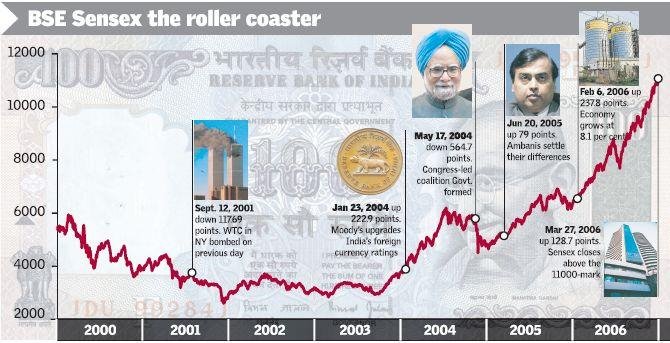
Hindistan dunyanin en hizli buyuyen ekonomilerinden bir tanesi. Bundan yaklasik 2 ay once Hindistan piyasasi hakkinda bir kac yazi yazmistim. O gunden bugune Hindistan sirketleri %15'e yakin deger kazandilar. Kisa vadede Hint senetleri pahali gib gorunuyor, Merkez Bankasi da faizleri arttirma yoluna gittigi icin hisselerin kisa vadede artik bu hizda yukselmeyecegini dusunuyorum. Ancak cok fazla dusecegini de tahmin etmiyorum (keske dusse de biz de ucuzundan uzun vadeli kagit alsak). Business Standard gazetesinin haberi:

"India, along with three other emerging markets, grabbed the honours in the first quarter of calendar 2006 with an average 20 per cent returns.

During the quarter, Moscow Times of Russia topped the chart with 22.35 per cent returns, followed by OSE All Share of Norway at 20.81 per cent and Karachi 100 of Pakistan at 20.19 per cent. In comparison, the benchmark BSE Sensex stood at the fourth spot with 20.03 per cent returns.

Among the other major markets, while Japan’s Nikkei rose 5.89 per cent, Hong Kong’s Hang Seng, Nasdaq composite, FTSE 100, and NYSE composite all gained over 6 per cent each. Australia’s S&P/ASX 200, Straits Times of Singapore, ISE National-100 of Turkey and AEX General of the Netherlands gained over 7 per cent each.

The only Asian index to lose ground was South Korea’s KOSPI, which fell around 1.4 per cent. Though the Sensex has hit record highs in the recent weeks, market players do not expect its sizzling run to continue. On April 10, the index closed at 11662.55 after a day of extreme volatility.

Sandip Sabharwal, chief investment officer (equities), Lotus India AMC, feels India would underperform other emerging markets over the next couple of months since it is already overvalued.

“At a forward P/E of 17, the Indian equity market is commanding a higher valuation compared with the average P/E of 10-13 for other emerging markets. So, in that sense, we might see some cool-off,” Sabharwal said."

Read More!